
IPTV: Internet Protocol Television
A comprehensive guide covering everything you need to know about IPTV technology, from basic concepts to advanced technical details, devices, protocols, and future trends.
What is IPTV?
IPTV Internet Protocol Television is a system through which television services are delivered using the Internet Protocol suite over a packet-switched network such as a LAN or the Internet, instead of being delivered through traditional terrestrial, satellite signal, and cable television formats.
Unlike traditional television broadcasting methods, IPTV provides the ability to stream source media continuously. This means users can watch live TV channels, access video-on-demand (VOD) content, and use time-shifted media features like catch-up TV and restart functionality.
IPTV is distinguished from other internet video streaming services by its ability to deliver live television broadcasts in real-time, similar to traditional broadcast TV, while also offering the flexibility and interactivity of internet-based streaming.
IPTV Subscription
Get reliable and affordable Irish IPTV with an IPTV Smarters Ireland subscription. We offer flexible subscriptions with a one-time payment and no long-term commitments, so you can enjoy top-quality TV content without hassle or hidden costs.
12 Months
- +58,000 Channels
- +97,000 Movies and Series
- 8K / 4K / Ultra HD Quality
- Netflix, Disney+, HBO Max, Prime, Apple TV...
- ALL Premium Sports Channels
- All Devices Supported
- 24/7 Support
- Built-in VPN Protection
- CATCH-UP TV Service
- 30-Day Money-Back Guarantee

24 Months
- +58,000 Channels
- +97,000 Movies and Series
- 8K / 4K / Ultra HD Quality
- Netflix, Disney+, HBO Max, Prime, Apple TV...
- ALL Premium Sports Channels
- All Devices Supported
- 24/7 Support
- 30-Day Money-Back Guarantee
3 Months
- +58,000 Channels
- +97,000 Movies and Series
- 8K / 4K / Ultra HD Quality
- Netflix, Disney+, HBO Max, Prime, Apple TV...
- Sports Channels
- All Devices Supported
- 24/7 Support
History and Evolution of IPTV
Early Development (1990s-2000s)
IPTV technology began to emerge in the 1990s, initially used by telecommunications companies to deliver television content over broadband networks. Early systems were limited by bandwidth constraints and required significant infrastructure investment.
Rapid Growth (2010s)
With the expansion of high-speed internet and improved compression technologies, IPTV services became more accessible to consumers. Major telecom providers launched IPTV services, and the technology gained mainstream acceptance.
Modern Era (2020s)
Today, IPTV has become a dominant force in television delivery, with millions of subscribers worldwide. The technology now supports 4K/8K streaming, multi-device viewing, and advanced features like cloud DVR and personalized recommendations.
How IPTV Works
The IPTV Architecture
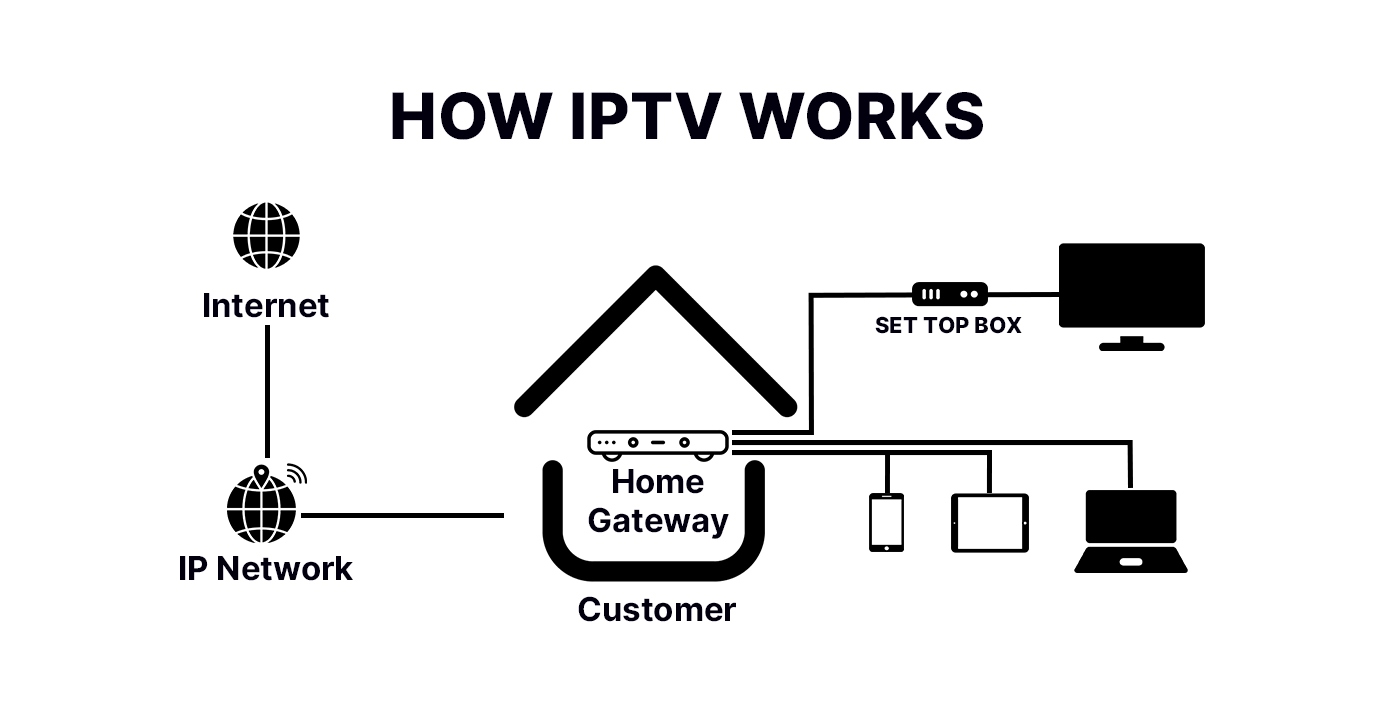
IPTV operates through a sophisticated architecture that includes several key components working together to deliver content to end users:
1. Content Sources
Content providers supply TV channels, movies, and other media. This content is encoded and prepared for transmission over IP networks using various video compression standards like H.264, H.265 (HEVC), or AV1.
2. IPTV Headend
The headend is the central facility that receives content, processes it (encoding, transcoding, and encryption), and packages it for distribution. It manages user authentication, channel lineup, and content scheduling.
3. Content Delivery Network (CDN)
CDNs distribute content across multiple geographic locations to reduce latency and ensure smooth streaming. When you request content, you're connected to the nearest server in the CDN.
4. Network Infrastructure
Your internet service provider's network carries the IP packets containing the video stream. Quality of Service (QoS) mechanisms prioritize video traffic to ensure smooth playback.
5. User Device & Application
Your device (Smart TV, mobile, tablet, or set-top box) runs an IPTV application that receives the stream, decodes the video, and displays it on your screen. The app manages authentication, channel selection, and playback controls.
The Streaming Process
- User Request: User selects a channel or content.
- Authentication: System verifies subscription credentials.
- Content Delivery: CDN streams content via IP network.
- Decoding & Display: Device decodes and displays video on screen.
Types of IPTV Services
Live Television
Real-time streaming of broadcast TV channels, similar to traditional cable or satellite TV. Content is delivered as a continuous stream with minimal delay, allowing users to watch live events, news, and scheduled programming as they happen.
Video on Demand (VOD)
Pre-recorded content library that users can access at any time. This includes movies, TV series, documentaries, and other content that can be streamed on-demand. Users have full control over playback, including pause, rewind, and fast-forward.
Time-Shifted Media
Services like catch-up TV and restart allow users to watch previously aired content. Programs that aired in the last few days remain available for viewing. Users can also restart a program that's currently airing from the beginning.
IPTV Protocols and Technologies
Streaming Protocols
- RTSP (Real-Time Streaming Protocol): Used for controlling media streaming servers. Establishes and controls media sessions between client and server.
- RTP (Real-Time Transport Protocol): Delivers audio and video data over IP networks with timing information for synchronized playback.
- HTTP Live Streaming (HLS): Apple's adaptive bitrate streaming protocol that breaks streams into small downloadable files, widely used in modern IPTV.
- MPEG-DASH (Dynamic Adaptive Streaming over HTTP): International standard for adaptive streaming, offering high-quality video delivery across different devices and networks.
- UDP Multicast: Used for efficient distribution of live content to multiple users simultaneously, reducing bandwidth usage.
Video Compression Standards
H.264 (AVC): Most widely used codec, excellent quality at lower bitrates. Standard for HD content delivery.
H.265 (HEVC): Provides 50% better compression than H.264, enabling 4K streaming with reduced bandwidth.
AV1: Next-generation codec with superior compression efficiency, ideal for 4K/8K content and low-bandwidth scenarios.
IPTV-Compatible Devices
IPTV can be used on a wide variety of devices, making it accessible to almost everyone. Here are the main device categories:
Smart TVs
Samsung, LG, Sony, Philips, TCL, Sharp, Panasonic, Toshiba, Hisense, Xiaomi, and more. Most modern Smart TVs support IPTV apps natively.
Android Devices
Android phones, tablets, Android TV boxes, and Fire TV Stick. Wide app support and flexible configuration options.
Apple Devices
iPhone, iPad, Apple TV. Native apps available through the App Store with seamless integration.
Computers
Windows, macOS, and Linux systems. Use web browsers or dedicated desktop applications for IPTV streaming.
Set-Top Boxes
MAG boxes, Formuler devices, NVIDIA Shield, and other dedicated IPTV boxes designed specifically for television streaming.
Gaming Consoles
PlayStation, Xbox consoles support IPTV apps, allowing you to stream on your gaming system.
Advantages of IPTV
Global Access
Watch content from anywhere in the world with an internet connection. Access international channels and content libraries regardless of your location.
On-Demand Content
Watch what you want, when you want. Extensive libraries of movies, TV shows, and series available for instant streaming without scheduling constraints.
Multi-Device Support
Use one subscription on multiple devices simultaneously. Watch on your TV, phone, tablet, or computer—all with the same account.
Cost-Effective
Often more affordable than traditional cable or satellite subscriptions while offering more content. Flexible payment plans and no long-term contracts.
High-Quality Streaming
Enjoy HD, Full HD, 4K, and even 8K quality content. Adaptive bitrate streaming ensures optimal quality based on your connection speed.
Massive Content Library
Access to thousands of live channels, tens of thousands of movies, and series from around the world—far more than traditional TV services.
Time-Shifting Features
Catch-up TV, restart live programs, pause and rewind live content. Never miss a moment with advanced playback controls.
No Equipment Needed
No satellite dishes, cable boxes, or complex installations. Just an internet connection and a compatible device—that's it!
IPTV vs Traditional TV
Technical Requirements for IPTV
Internet Connection
- Minimum: 5 Mbps for SD quality
- Recommended: 15-25 Mbps for HD
- Optimal: 50+ Mbps for 4K streaming
- Stable, low-latency connection preferred
Device Specifications
- Compatible operating system
- Sufficient processing power
- Hardware video decoding support
- RAM: 2GB minimum, 4GB+ recommended
Network Setup
- Quality router with good coverage
- Ethernet connection for best stability
- QoS settings for video prioritization
- Open ports if required by provider
Popular IPTV Applications
IPTV Smarters Pro
User-friendly interface, supports M3U and Xtream Codes API, EPG support, and multi-screen functionality.
VLC Media Player
Open-source media player that supports M3U playlists and various streaming protocols.
TiviMate
Premium Android TV app with advanced features, EPG, recording capabilities, and beautiful interface.
Perfect Player
Android app with support for M3U playlists, EPG, and customizable interface.
Kodi
Open-source media center with extensive plugin support for IPTV integration.
GSE Smart IPTV
iOS and Android app supporting M3U playlists, EPG, and multiple playlist management.
The Future of IPTV
Enhanced Immersive Experiences
Integration of VR and AR technologies will create immersive viewing experiences, allowing users to interact with content in new ways.
AI-Powered Personalization
Artificial intelligence will provide more sophisticated content recommendations and personalized viewing experiences based on user preferences.
8K and Beyond
As internet speeds continue to increase, 8K streaming will become standard, with even higher resolutions on the horizon.
Cloud-Based Infrastructure
Increased adoption of cloud-based IPTV services will enable more scalable, flexible, and cost-effective solutions for providers.
5G Integration
5G networks will enable seamless mobile IPTV streaming with ultra-low latency and high bandwidth, making mobile viewing even better.
Social Integration
Social features like live chat, shared watchlists, and synchronized viewing will enhance the community aspect of IPTV.
Common IPTV Terminology
- M3U Playlist
- A file format that contains multimedia playlists, commonly used to store IPTV channel lists and stream URLs.
- EPG (Electronic Program Guide)
- An on-screen guide that displays scheduling information for current and upcoming television programs.
- VOD (Video on Demand)
- A system that allows users to select and watch video content whenever they choose, rather than at a scheduled time.
- CDN (Content Delivery Network)
- A geographically distributed network of servers that work together to provide fast delivery of content to users.
- Adaptive Bitrate Streaming
- Technology that automatically adjusts video quality based on available bandwidth to ensure smooth playback.
- Multicast
- A method of transmitting data to multiple destinations simultaneously, commonly used for live IPTV broadcasts.
- Set-Top Box (STB)
- A device that connects to a television and receives IPTV signals, decoding them for display.
- Catch-Up TV
- A feature that allows users to watch previously aired programs within a specified time window after broadcast.
- Time-Shifting
- The ability to watch content at a time different from when it was originally broadcast, including pause, rewind, and fast-forward.
Frequently Asked Questions About IPTV
Is IPTV legal?
IPTV technology itself is completely legal. It's a legitimate method of delivering television content over the internet. However, the legality depends on whether the service provider has proper licensing for the content they're streaming. Always use reputable, licensed IPTV services to ensure compliance with copyright laws.
Do I need special equipment for IPTV?
In most cases, no special equipment is needed. You can use your existing Smart TV, smartphone, tablet, computer, or any device with internet connectivity and an IPTV app. Some users prefer dedicated set-top boxes for better performance, but they're not required.
What internet speed do I need for IPTV?
For standard definition (SD), you need at least 5 Mbps. High definition (HD) requires 15-25 Mbps. For Full HD and 4K streaming, 50+ Mbps is recommended. Keep in mind that these are per-stream requirements, so if multiple devices are streaming simultaneously, you'll need proportionally more bandwidth.
Can I watch IPTV on multiple devices?
Yes, most IPTV services allow you to use your subscription on multiple devices simultaneously. The number of concurrent streams depends on your subscription plan. Some providers offer multi-screen packages that support 2, 3, or more simultaneous connections.
What's the difference between IPTV and streaming services like Netflix?
While both use internet streaming, IPTV focuses on live television channels and real-time broadcasts, similar to cable or satellite TV. Services like Netflix primarily offer on-demand movies and TV shows. IPTV typically includes both live channels and VOD content, providing a more comprehensive television experience.
Can I record IPTV content?
Recording capabilities depend on your IPTV app and service provider. Some apps and set-top boxes offer DVR (Digital Video Recorder) functionality, allowing you to record live TV for later viewing. Cloud DVR services are also becoming increasingly common in IPTV offerings.
Ready to Experience IPTV?
Join thousands of satisfied customers enjoying premium IPTV service with over 58,000+ channels and 97,000+ movies and series.
Get Started Today